Choosing where to build a commercial greenhouse is one of the most consequential decisions a grower will make. Long before crop plans, equipment selection, or operational strategy come into play, the site itself quietly determines how efficiently the greenhouse will perform and how profitable it can become.
For commercial growers, this isn’t just about finding available land. It’s about selecting a location that supports consistent production, controlled energy use, and scalable operations over time.
At Ceres, we approach site selection as part of a fully integrated system, combining climate data, solar performance, infrastructure access, and advanced energy modeling to ensure each greenhouse is optimized from the ground up. If you’re in the early planning stages, it’s worth understanding how each of these factors works together.
What is the best location for a commercial greenhouse?
The best location for a commercial greenhouse is a site with strong year-round solar exposure, reliable access to water and power, minimal shading, and favorable climate conditions. Ideal sites also allow for optimal orientation and can be evaluated using energy modeling tools to predict sunlight distribution and energy performance before construction.
With that foundation in mind, the real work begins—evaluating how a specific site will perform under real-world conditions.

The First Filter: Can the Site Support Commercial Operations?
Before diving into optimization, experienced growers quickly eliminate sites that simply won’t work.
A greenhouse may look viable on paper, but without dependable access to power, water, transportation, and connectivity, operational challenges will surface almost immediately. Commercial facilities often require three-phase power, reliable water sources, and sufficient road access for construction and distribution.
Equally important, and often overlooked, is connectivity. Modern greenhouses rely on automated control systems like the SunSense™ to manage climate, irrigation, and energy systems. Without stable internet, those systems lose much of their value.
This early-stage filtering saves time and capital by focusing only on sites that can realistically support commercial-scale production.

Evaluate Solar Access and Light Distribution
For commercial growers, light is more than a resource—it’s a primary driver of yield, crop quality, and energy consumption.
Historically, evaluating light meant looking at general indicators: how many sunny days a region receives, whether the site faces south, or if nearby trees or mountains cast seasonal shadows. While those factors still matter, they only tell part of the story.
At Ceres, we use advanced energy modeling software—IESVE (Integrated Environmental Solutions Virtual Environment)—to simulate exactly how a greenhouse will perform before it’s built.
Instead of estimating sunlight, we can:
- Track the precise position of the sun at any hour of the year
- Model how sunlight passes through greenhouse glazing
- Analyze how that light distributes throughout the interior growing space
- Identify zones of underperformance, overheating, or inefficiency
This level of insight changes how decisions are made. For example, two sites with similar sunlight on paper may perform very differently once you account for terrain, seasonal angles, and internal light distribution. With modeling, we can optimize:
- Greenhouse orientation
- Glazing strategy (see our greenhouse systems and structures)
- Crop layout and growing zones
- Integration with heating and cooling systems
For commercial growers, this means fewer surprises and a facility that is tuned for performance from day one.
Below is an example of a shade analysis for a Ceres HighYield™ Kit greenhouse in the winter and summer. This design software allows us to use a simulation to identify the best positioning and orientation for your greenhouse, taking into account all the nearby possible obstructions.

Infrastructure: Water, Power, and Energy Strategy
Once solar performance is understood, infrastructure becomes the next major driver of long-term success.
Electricity is often the most significant constraint. Many commercial greenhouses require 480V three-phase power, which isn’t always readily available, especially in rural areas. Extending power infrastructure can quickly become one of the highest upfront costs if not addressed early.
Water availability is equally critical. While treatment systems can address quality issues, they cannot compensate for insufficient supply. Reliable, scalable access to water is non-negotiable for commercial operations.
For growers focused on long-term efficiency, site selection also presents an opportunity. Integrating renewable energy systems (such as solar PV) can significantly reduce operating costs when paired with an energy-efficient greenhouse design. At Ceres, these systems are evaluated together as part of a broader commercial greenhouse design strategy, ensuring alignment between infrastructure and performance goals.

Wind, Weather, and Structural Impacts
Not all environmental factors are immediately visible, but for commercial growers, they can have a lasting impact on both capital costs and operational performance.
Wind is a prime example. Highly exposed sites often require more robust structural systems to meet code requirements, increasing upfront construction costs. Over time, wind also contributes to heat loss, air infiltration, and wear on mechanical systems, driving up operating expenses.
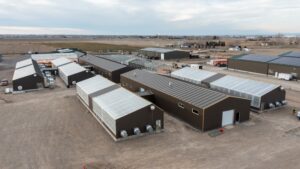
Winds also increase the structural loads on the greenhouse frame, mandating stronger roof framing. This, in turn, can add to the cost if wind loads are significant. For example, Ceres designed and built a commercial cannabis greenhouse in Leadville, Colorado – a site with 120 mph gusts. The structure required heavy-gauge steel I-beams rated for the high wind loads. A super energy-efficient greenhouse in the end, the wind loads were a major factor in the commercial greenhouse design and engineering.
A final deterrent is that winds ultimately increase the rate of heat loss through a year-round greenhouse. They both add to air infiltration (cold air blowing into the structure) and create pressure differentials around the building. Differences in pressure in turn increase air movement, making a year-round greenhouse less energy-efficient in the winter.
Wind, and other forms of extreme weather, are not just things to react to—they can be modeled and understood in advance.
Using advanced tools like IESVE, we’re able to simulate how air moves both around and through the greenhouse structure. This includes analyzing how prevailing winds interact with the building envelope, how air infiltrates through openings, and how airflow patterns distribute within the growing space.
These insights allow us to:
- Identify areas prone to heat loss or drafts
- Optimize ventilation strategies and system placement
- Reduce stress on crops caused by uneven airflow
- Improve overall climate consistency within the greenhouse
Whenever possible, experienced growers still prioritize naturally protected locations—using terrain, vegetation, or orientation to reduce exposure. But when that’s not an option, modeling tools like IESVE provide a powerful way to design for real-world conditions before construction begins.
To learn more about how advanced modeling can improve greenhouse performance, explore our greenhouse consulting services.
Site Conditions: Soil, Flooding, and Subsurface Constraints
While above-ground conditions get most of the attention, subsurface factors can significantly impact feasibility.
Flood risk is an obvious concern, but others are less visible:
- High water tables can complicate foundations
- Shallow bedrock can limit geothermal system installation
- Soil conditions can influence construction methods and cost
These factors are especially important for growers considering systems like GAHT® or other ground-coupled technologies, which rely on subsurface conditions to function effectively.
Navigating Zoning and Permitting
Even the ideal site can stall without proper approvals. Zoning regulations vary widely, and many municipalities are still unfamiliar with modern controlled-environment agriculture. As a result, commercial greenhouse projects often require additional explanation and coordination.
Early engagement with local authorities is essential. Demonstrating the greenhouse’s energy efficiency, structural integrity, and agricultural value can help streamline approvals and reduce delays.
Proximity to Labor and Markets
While environmental and infrastructure factors often take priority, proximity to labor and markets plays a meaningful role in long-term viability.
Reliable labor access supports consistent operations, while proximity to customers reduces transportation costs and improves product freshness, critical for commercial growers operating at scale.
In many cases, the “best” site is not simply the cheapest land, but the one that balances operational efficiency with market access.
Site Selection Is a Performance Decision
For commercial growers, choosing a greenhouse site is not just a real estate decision; it’s a performance strategy.
Every factor—light, infrastructure, climate, and location—feeds into a system that determines how efficiently the greenhouse will operate over its lifetime.
With today’s tools, including advanced solar and energy modeling through IESVE, growers no longer have to rely on assumptions. Instead, they can make informed decisions based on how a greenhouse will actually perform in a given location.
At Ceres, this integrated approach allows us to design greenhouses that are not only tailored to their environment but optimized for it.
If you’re evaluating potential sites or planning a new facility, our team can help you model and compare options before you commit.